Library
WEKID™ Resources Library
Ratified standards, foundational publications, research, demos, tools, partners, and implementation resources — gathered in one library with each item’s role made explicit.
Normative publications
WEKID Standards Catalogue
Use the Standards page as the authoritative register for current releases, companion standards, superseded versions, and conformance relationships.
Epistemic Maturity and AI Decision Authority
The normative core: maturity, the Trust Bridge, authority levels, gating, evaluation independence, conformance, and governance.
Sector Calibration and Authority Alignment
The normative companion for adapting thresholds, authority constraints, and evaluator assurance without weakening the protected core.
Publication model
Standards, research, and foundation — each has a different role
WEKID-STD-001 v1.2.1 defines the normative core, while WEKID-STD-002 v1.1 governs sector calibration as a normative companion. The Foundational Whitepaper v1.3 preserves the intellectual basis and explanatory rationale. Research papers are informative and can influence the standard only through the governed RFC process.
Featured resources · Executive perspective
Beyond Job Titles: How AI Behavioral Personas Shape Adoption
Roles decide what people can access. Behavior decides how and when AI is adopted. A marketing manager ships AI-generated campaigns with little review; a cybersecurity chief rejects AI-written compliance evidence. Same tools, opposite behavior, and neither appears on an org chart. This executive perspective maps four AI behavioral personas — Pioneer, Explorer, Consumer and Skeptic — by depth of use and trust in output, shows how each speeds up or stalls adoption, and explains how WEKID™ replaces habit with an evidence-based determination of AI decision authority.
Ten Foundational Questions
Origins, two models, authority levels, the Trust Bridge, and practical implementation, with source links.
Read the Q&A
WEKID™ Open Standard for Epistemic Maturity and AI Decision Authority v1.2.1
The normative core of WEKID. Version 1.2.1 restores four previously accepted amendments covering precedence resolution, overseer-engagement decay, gate classification, and verdict recording. It carries forward the evaluator-independence provisions.
Download document
WEKID™ Open Standard for Sector Calibration and Authority Alignment Protocol v1.1
The normative companion to WEKID-STD-001 v1.2.1. Governs how sector calibration profiles are developed, validated, ratified, and maintained. Version 1.1 adds evaluator provenance disclosure and tests on material the evaluator has not seen.
Download document
WEKID™ Foundational Whitepaper v1.3
Historical and Intellectual Foundation of the WEKID Open Standard. The document that captured the technical foundation of WEKID that led to the development of standard framework.
Download document
WEKID™ Foundational Companion Paper Version 1.3
This companion paper was reviewed and approved by the WEKID Community RFC process. It augments the WEKID Foundational Paper and isolates one determinant that the paper does not yet formalize: the incentives and engagement of the human who holds or oversees the decision.
Download documentBeyond Job Titles: How AI Behavioral Personas Shape Adoption
Enterprises usually track AI adoption by roles and org. This article introduces behavioral personas (Pioneer, Explorer, Consumer and Skeptic), shows how each one speeds up or stalls adoption, and offers practical steps to manage them without labeling employees. It also explains how WEKID™ keeps behavior separate from decision authority, so evidence, consequence and policy decide what AI may do.
Read ArticleDevSecOps for the Masses
DevSecOps for the masses is a research article that argues how DevSecOps must work for the AI-built application era. It does not mean everyone learns DevSecOps. It means the pipeline arrives with the code, generated by the same act, on by default, and not editable by the thing it governs. And the authority to release arrives separately — attached to a person.
Read ArticleGoverning Machine Learning: The Model is Not the Decisions
Machine learning is probabilistic AI, and so is generative AI. This article applies the Epistemic Maturity Model and the Decision Authority Model to classical ML, using ten cases from the WEKID Failure Library to show why the failures that matter are almost never accuracy failures.
Read ArticleI Refuse to Be Tokenized: The Ontology Flip and the Transfer of Epistemic Authority from Humans to Machines
The token economy has reversed the direction of ontology. Instead of people stating what concepts mean and machines operating inside that, organizations now reconstruct meaning from machine output and let it govern consequential decisions. This position piece names the reversal, shows how authority transfers through convenience rather than intent, and draws the boundary.
Read ArticleInteractive Governed Delivery
The Governed Delivery Platform - Interactive is a WEKID reference implementation: an application somebody built in an afternoon, with no tests, no review, just prompt engineering, is brought under governance while you watch. The demo takes about twenty minutes. Requires a login by arrangement.
Request AccessDecision Lab
Learn through four guided modules and synthetic decision scenarios. Compare computed authority results and export JSON or CSV audit records. An educational prototype with illustrative rules; lesson progress remains local to each browser.
Launch demoGovernance Assessment
Start a sample or application-development assessment, calculate an indicative WEKID maturity score, and inspect authority alignment, gates and recommended actions. Export JSON or CSV results. Guided and certified assessment paths retain their existing intake requirements.
Launch demoPRD Builder
Build a product requirements document with accountable ownership, evidence provenance and WEKID governance controls. Work through learning modules and export generated planning and delivery artifacts for engineering review.
Launch demoSwarm Containment
Compare governed and ungoverned swarm behavior in a synthetic containment console. Run, resume or step through proposals, inspect decision gates and evidence trails, and replay a finite incident sequence. A counterfactual reference demonstration.
Launch demoAgent Governance Console
Evaluate proposed agent actions, inspect rendered decisions, and explore how evidence, policy and human review constrain authority. Export policies and executable workflow definitions from the demonstration.
Launch demoDigital Twin Simulator
Run a synthetic digital twin rollout and inspect its predicted outcomes, five-layer maturity assessment, Trust Bridge result and decision authority determination. Compare how risk, policy and evidence change the result.
Launch demoReference Capabilities
The art of the possible — reference implementations that show partners and enterprises what to build.
Explore capabilitiesCapability Blueprint
The full scope of WEKID-based capability, mapped end to end.
View the blueprintWhat Gets Built on WEKID
Governed outputs, authority-aligned systems, and audit-ready governance.
See outcomes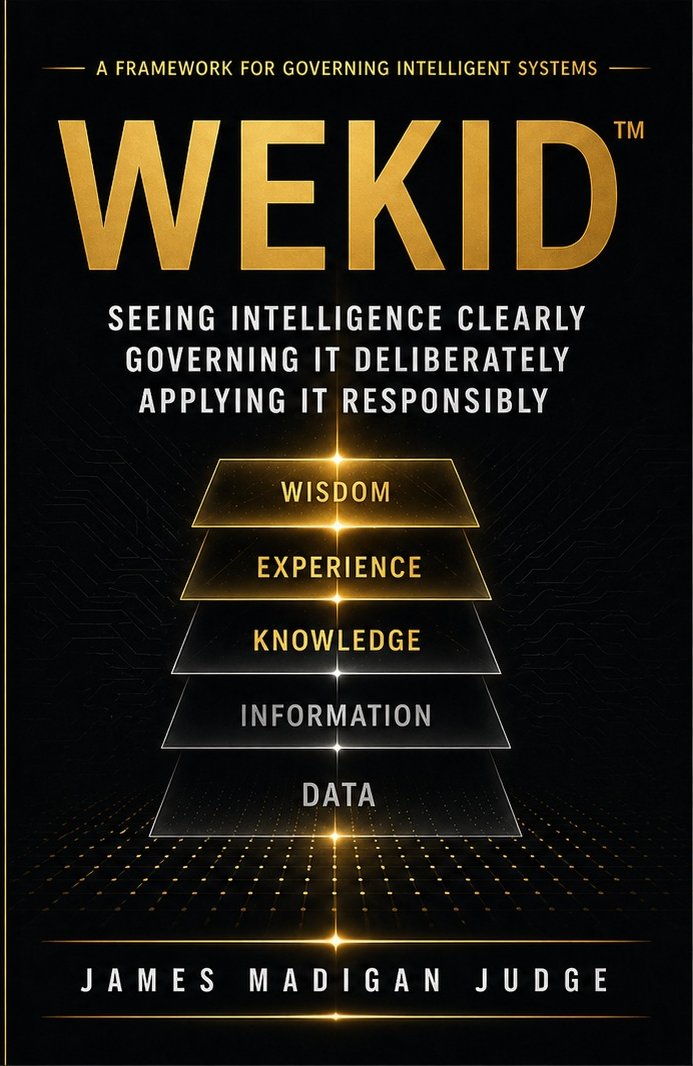
The Complete WEKID Trilogy
Foundations, governance, and applied intelligence in one volume.
Purchase
Foundations of Intelligence
The conceptual groundwork of the WEKID model.
Purchase
Governing Intelligence
Oversight, controls, and accountability for AI systems.
Purchase
Applying WEKID
Putting the framework to work in real deployments.
Purchase
Epistemic Authority
Drawing on Zagzebski's theory of epistemic authority, WEKID distinguishes deference to judgment from decision authority — the right to act on it.
View on Amazon
The WEKID Master Whitepaper Executive Brief
Contains the Executive Summary, Introduction and Table of Contents to the complete WEKID Master Whitepaper Version 1.3
Download Brief
Failure Library Executive Brief
Recurring AI failure modes mapped to WEKID layers and governance responses.
Request document
The WEKID™ Interactive Demonstrations
Summary brief on the three hands-on demonstrations that show — in minutes — how the two-model WEKID™ framework turns AI governance from policy language into operational decisions.
Download Brief
The WEKID™ Framework: Two Complementary Models
Briefing on the Epistemic Maturity Model, which evaluates the quality and maturity of AI-generated knowledge, and the AI Decision Authority Model, which governs how much authority may be delegated.
Download BriefWEKID™ ROI Calculator
This calculator helps you build the business case for a governed AI operating model—modeling value across risk reduction, delivery acceleration, productivity, compliance efficiency, and rollout readiness. Use it for discovery, pilot framing, proposal development, and board-level value conversations.
Launch toolWEKID™ Sector Calibration Profile
This online edition of the calibration workbook allows you to charter your working group, calibrate layer weights, gates and authority bands, back-test every corpus case through the live decision matrix, log public comment, and assemble the evidence the Standards Council needs to ratify your profile.
Launch toolExecutive Briefing
A concise board-level overview of the framework and outcomes.
Request briefing
Certification Program
Training and credentialing for WEKID practitioners.
Explore programWEKID Partner Program
Become a training, product, or solution partner.
View the program
Cambridge Consultant Solutions
WEKID-based enterprise AI assessment, governance, and buildout services.
View profile
CompetitiveJuice Pro
Human-powered competitive intelligence governed by WEKID scoring.
View profile
WEKID™ Sector Calibration Protocol
The Working-Group-Governed Process for Calibrating the Epistemic Maturity Weights and Aligning the Decision Authority Levels by Sector
Download documentDatacenter Digital Twin
Explore a guided simulation of governed machine-learning decisions in datacenter operations. Construct and evaluate decisions, inspect supporting evidence, and follow how maturity, consequence and policy constrain operational authority.
Launch demo